What Is Pay-Per-Call? A Plain-English Explainer for Home Services
Pay-per-call means paying for a phone call that passes agreed rules, not a click. How it works, where the money leaks, and when it is the wrong tool.
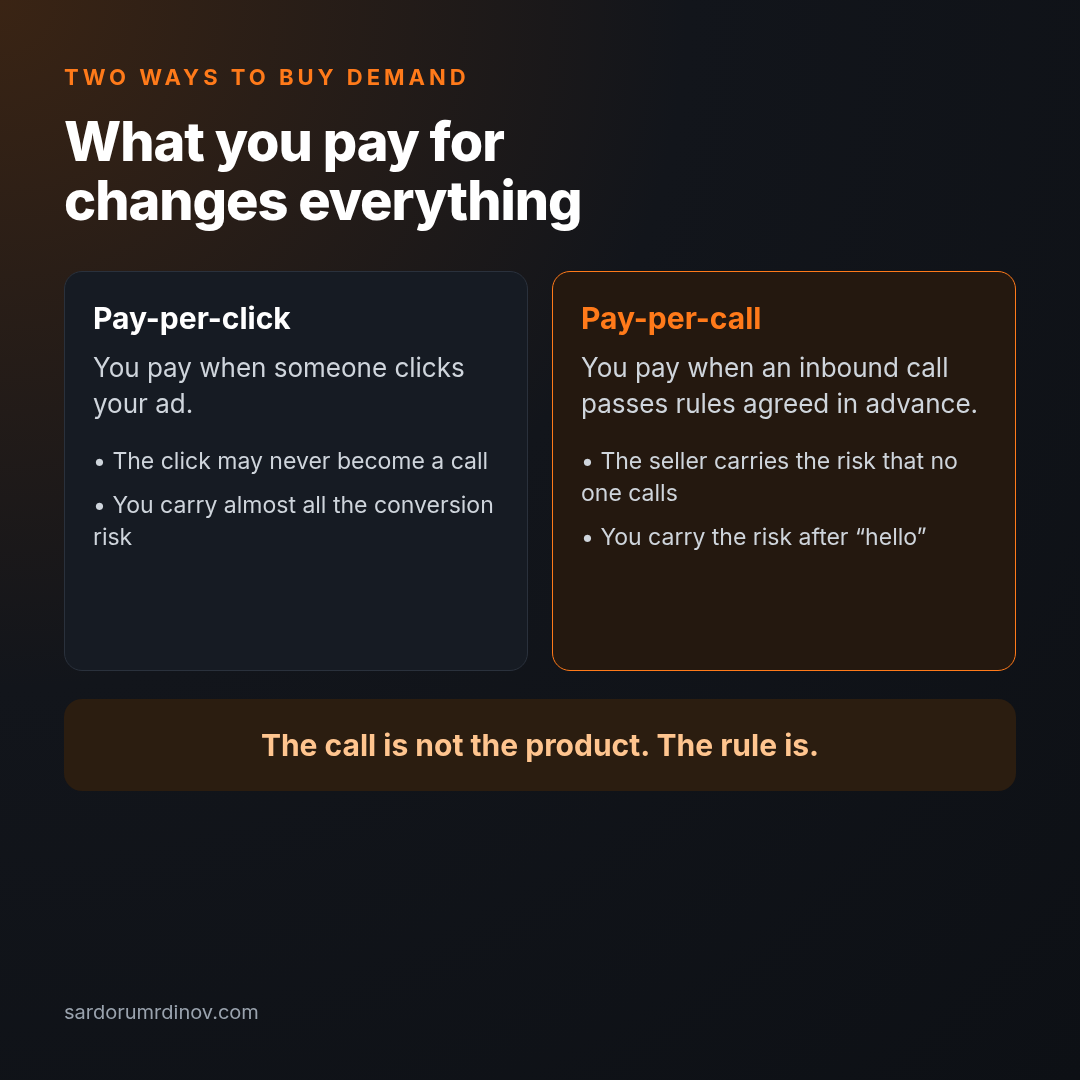
Short answer: Pay-per-call is a way of buying demand where a home service company pays for an inbound phone call from a customer, not for an ad view, a click or a web form. It pays only when the call meets rules agreed in advance: the right service, the right area, business hours, not a repeat caller, and usually a minimum length of conversation once the call connects. The call is not really the product. The product is the rule that decides which calls get paid, and the process that settles the arguments afterwards. An owner who understands those rules gets a flexible source of jobs. An owner who doesn't is paying for a ringing phone. This is an operator's view, not a study: I found no public, independent benchmark for how well pay-per-call performs in home services. Where I cite a number, I say whose it is. Every other number is a labeled example, and your own tracking is the only benchmark that counts.
Why the phone call still matters in home services
When a water heater leaks or the air conditioning dies in July, most people don't want to fill in a form and wait. They want a person. That is why so much home service demand still arrives by phone, and why a call carries a different intent than a click. A click is curiosity. A call about a broken system is often a job that needs a truck today. That is my experience as an operator, not a measured fact, and it varies by trade: a kitchen remodel is a different buyer from someone standing in water.
The question is not "is pay-per-call good or bad?" It is "what exactly am I paying for, and what has to happen after the phone rings for it to make money?"
What a pricing conversation taught me about paying for demand
I began my career in the trades as a technician. Today I run home service companies, and I spend a lot of time on the side that moves calls between the people who generate them and the companies that take the job. So I see the same call from both ends, and I have a stake on both sides, which is one more reason the numbers here are examples rather than claims.
On a call with other service business owners, the conversation turned to price. My advice was simple. Walk your competitor's customer path yourself. Look at where the strong competitors buy their leads, not the classifieds and marketplaces, and find out what they actually charge. Don't measure yourself against the cheapest operator in town. And before you hire a salesperson, have a written price policy and real confidence in your price. Without that, the first time a customer says "too expensive, give me a discount," the discount wins, the salesperson still gets the commission, and your economics fail.
I bring this up in an article about pay-per-call because it is the same lesson from a different angle. When you pay for a call, you have paid for a conversation. You have not paid for a job. If what happens on that call is a weak greeting, no price confidence and a quick discount, you paid to lose money. Pay-per-call does not fix a business that cannot convert a conversation. It makes the cost of that weakness visible faster.
How pay-per-call works, step by step
There are usually four parties, even when the homeowner only sees one phone number.
- The homeowner has a problem and dials a number from a website, search ad or directory listing.
- The publisher generated the call: a site owner, a media buyer, a local directory. The publisher is paid when a call qualifies.
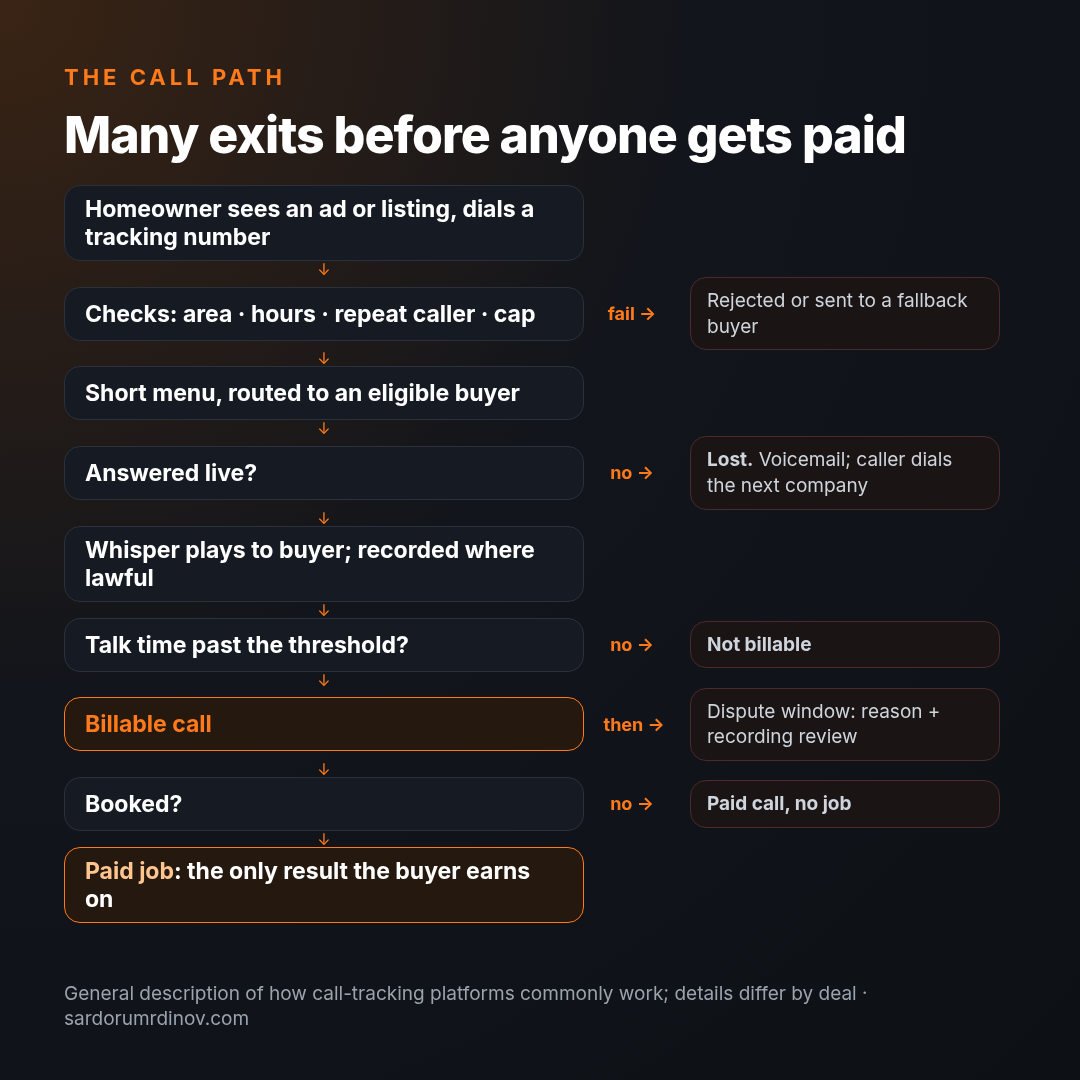
- The call-tracking platform sits in the middle. The number the homeowner dialed is a tracking number assigned to one publisher and one declared source. In the seconds after the dial, the platform can check the caller's area, the time of day, recent calls from the same number and the buyer's cap, play a short menu, pick an eligible buyer, play a "whisper" telling the buyer's team where the call came from, connect it, and record it where the law allows.
- The buyer takes the call: a local contractor, a multi-location company, or a buyer network that resells calls.
Often a network sits between publishers and buyers. Each layer takes a margin and has its own definition of a "good" call. That is where most of the confusion comes from.
The diagram shows the whole path. Notice how many exits there are before anyone gets paid, and that "billable" and "paid job" are different boxes.
Two calls, two outcomes
These two calls are composites that show the mechanics. They are not specific customers, and the times are examples.
The call that turns into a job. A homeowner searches "AC not cooling," taps a search ad and dials the number on it. That number belongs to one publisher and one declared source. A short menu asks her to press 1 for repair. In the background the platform confirms that she is inside a buyer's service area, that the buyer is open, that she hasn't called in recent weeks and that the buyer is under today's cap. A two-second whisper tells the dispatcher "ad call, AC repair." A person answers within seconds. They talk for six minutes, agree on a price range for the diagnostic, and book a technician for the same afternoon. The call passed the duration threshold, so it is billable. The job is done and paid. Nobody disputes anything, because everybody got what the deal promised.
The call that disappears in the middle. A homeowner finds a garage door company on a directory listing and dials. He needs a new opener; the listing was about replacing doors. The buyer's phone rings out and goes to voicemail, and he dials the next listing. Under a typical deal that call is not billable, because nobody connected. But the publisher may have paid for the click, the network earned nothing, and a homeowner with a real need is now someone else's customer. The call was lost at the answer step, the one step the buyer fully controls. In my view that is also the cheapest problem in this business to fix.
The rules that decide the money
When people argue about whether pay-per-call "works," they are usually arguing about unnamed rules. Where a number comes from a published source, I link it. Everything else is a typical setup, offered as an example, not a market rate.
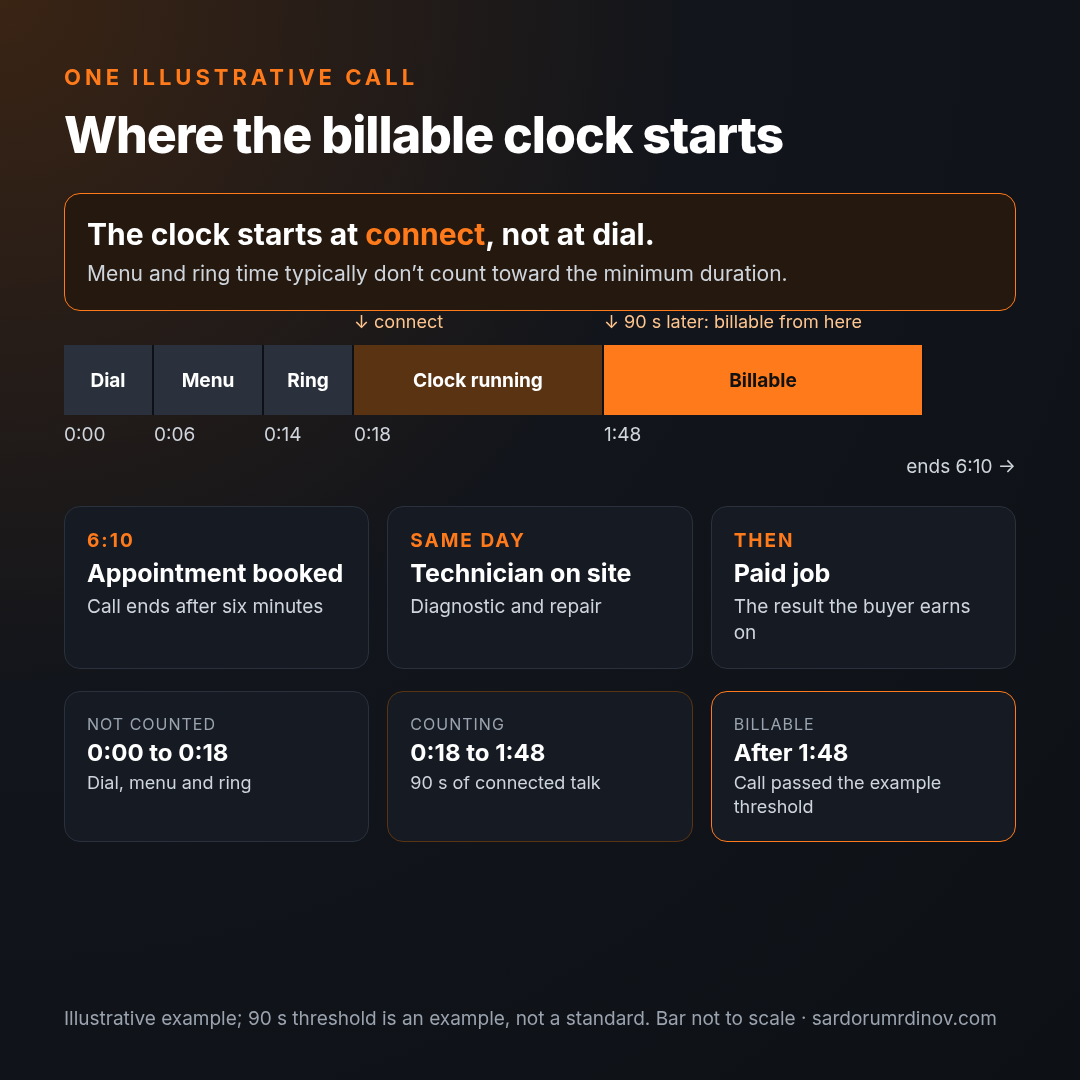
When the clock starts. Most deals pay only if the call lasts past a minimum time. One pay-per-call vendor's published playbook describes qualification as "usually" a 90 to 120 second duration, an in-state caller and business hours; one marketplace's page describes minimum durations as typically 60 to 120 seconds. Owners miss where that clock starts. In typical deals it starts when the buyer's line connects, not when the homeowner dials, so menu and ring time don't count. That protects the buyer from paying for a caller who sat on hold. It also means a slow pickup costs the buyer twice: callers hang up before the clock starts, and the ones who stay are already annoyed.
Geography. The caller must be inside the buyer's service area, usually checked by ZIP code or area code. Area codes are a weak proxy, because people keep their cell numbers when they move, so a real local customer with an out-of-state number can get rejected.
Hours. Calls outside the buyer's open hours are often not billable, or are routed to a different buyer who covers nights and weekends.
Duplicates. A repeat caller inside a set window is usually paid only once. Windows typically run 7 to 30 days and are negotiated deal by deal.
Exclusive or shared. An exclusive call goes to one buyer. A shared lead may go to several competitors, which changes both price and odds of winning.
Caps. Buyers usually cap how many calls they take per day or week, because a call with no technician available is worth nothing. Calls over the cap are typically not paid.
Disputes. Deals usually let a buyer dispute calls that broke the rules within a short window, typically a few days, often around 3 to 7. The buyer has to name the call and the reason. Common reasons: wrong service, outside the area, the caller hung up before anyone answered, a repeat caller, spam or a robocall, and "no intent," meaning a price shopper, a job seeker or a vendor selling something.
Read together, the rules are the real product. A buyer is not paying "$X per call." The buyer is paying $X for a call that passed a specific filter and survived the dispute window. Two prices for "an HVAC call" can both be honest and still differ a lot, because they buy two different filters. Comparing them as one "cost per lead" is how owners conclude a source is cheap when it is expensive, or the reverse.
What a qualified call pays: published ranges, not market rates
Owners always ask what a call "costs." There is no public market price. What exists are ranges individual sellers publish about their own marketplaces, mostly what publishers are paid per qualified call. If you want to see how a marketplace presents this, LeadBank, the pay-per-call and pay-per-lead marketplace we run, is one example. Here are two published ranges from other sellers, in US dollars:
- HVAC: $30 to $80 on one marketplace's published list; $35 to $65 in one vendor's playbook.
- Plumbing: $25 to $70 on the same marketplace list; $50 to $150 in the same vendor playbook, which says emergency calls lean toward the high end.
- Appliance repair: $15 to $40, from the marketplace list only.
- Garage door repair: $20 to $50, from the marketplace list only.
Treat these as one marketplace's and one vendor's advertised ranges, not what you should pay. The vendor page itself quotes different figures elsewhere, which shows how loose they are. They describe publisher payouts; a buyer who buys through a network pays more, because the network keeps the spread. And they say nothing about how many calls become jobs. I found no public source for how many calls end up billable, so I won't print a number. Some share of every source fails the rules, and you only learn yours by tracking it.
Where calls leak before they become jobs
The best public data I found on what happens after the phone rings is not about pay-per-call. It is a 2026 benchmark report from a call-analytics company, built from calls tracked on its own platform across nine home service segments, such as HVAC, plumbing and restoration. Its figures are averages across that company's customers, so they describe all inbound calls, not paid calls, and not your market. The shape is still useful.
Across those businesses, 52% of callers reached a person. Of the answered calls, 38% were leads, which the report treats as real job opportunities. And 45% of those leads converted on the call. Multiplied through, that is roughly 52 answered, about 20 leads and about 9 booked jobs for every 100 inbound calls.
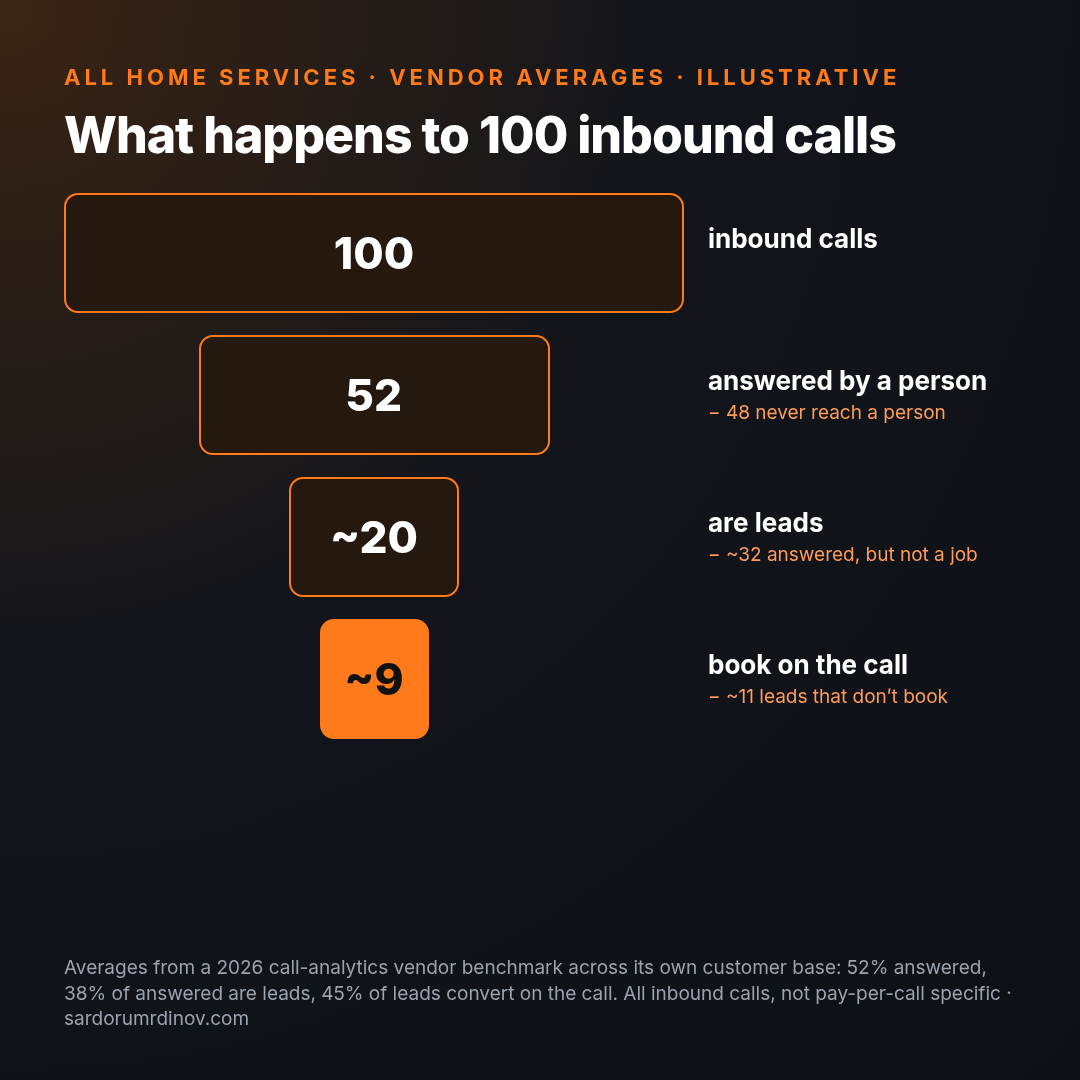
The 52% includes misdials and hang-ups; for calls longer than 30 seconds the same report puts the answer rate at 73%. So the leak shrinks once you filter out noise, but it never closes. Answer rates also varied by segment, from 32% to 74%: picking up the phone is the step where businesses differ most.
Other common leaks are long phone menus, callers outside the area, callers who wanted a different service, long holds, and a price objection the person on the phone isn't ready for. That last one is the pricing story above.
How bad calls get caught
Every call economy attracts people who game the rules. Most abuse targets the duration rule, because that is what triggers payment. The vendor playbook cited above lists repeat callers, spoofed internet-phone numbers and duration-stuffing among the patterns it sees in home services. Typical patterns, and how they usually get caught:
- Coached callers. Someone follows a script long enough to pass the threshold. Call reviews and transcripts show the same voice or phrasing, with no real job behind it.
- One voice, many numbers. One caller behind rotating or spoofed numbers. Voice matching and repeated caller IDs give it away.
- Spam and robocalls. Caught by keyword or automated classification, and by very short or silent calls.
- Padded duration. Hold music, a menu loop or dead air. Caught by comparing talk time with connect time and reading the transcript.
- Misdeclared traffic. An ad promises a price or service the buyer doesn't offer, or several sources hide behind one tracking number. Caught by comparing the declared source with the caller's first words.
- Out-of-area volume and sudden bursts. Area codes that don't match the stated ZIP, or an overnight spike far above a source's baseline. Caught by volume alerts.
Buyer complaints usually sound like "these leads aren't real" or "the caller never wanted service." Only evidence settles those arguments: the recording and a reason code, filed inside the dispute window. That is why the most useful screen in this business is a boring one.
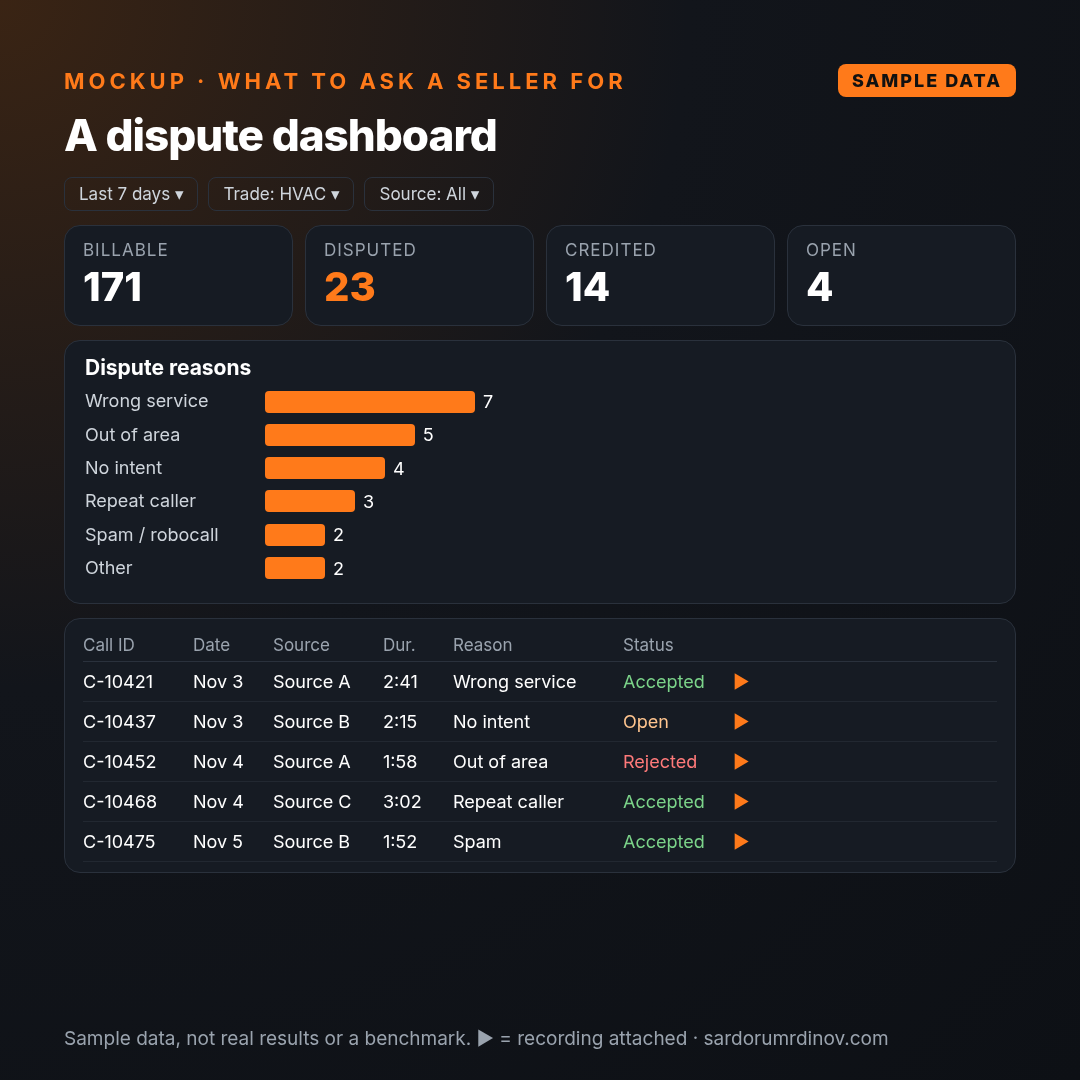
If a seller can't show you something like this, with a recording behind every disputed call, you are trusting rather than verifying.
Pay-per-call next to the other ways to buy demand
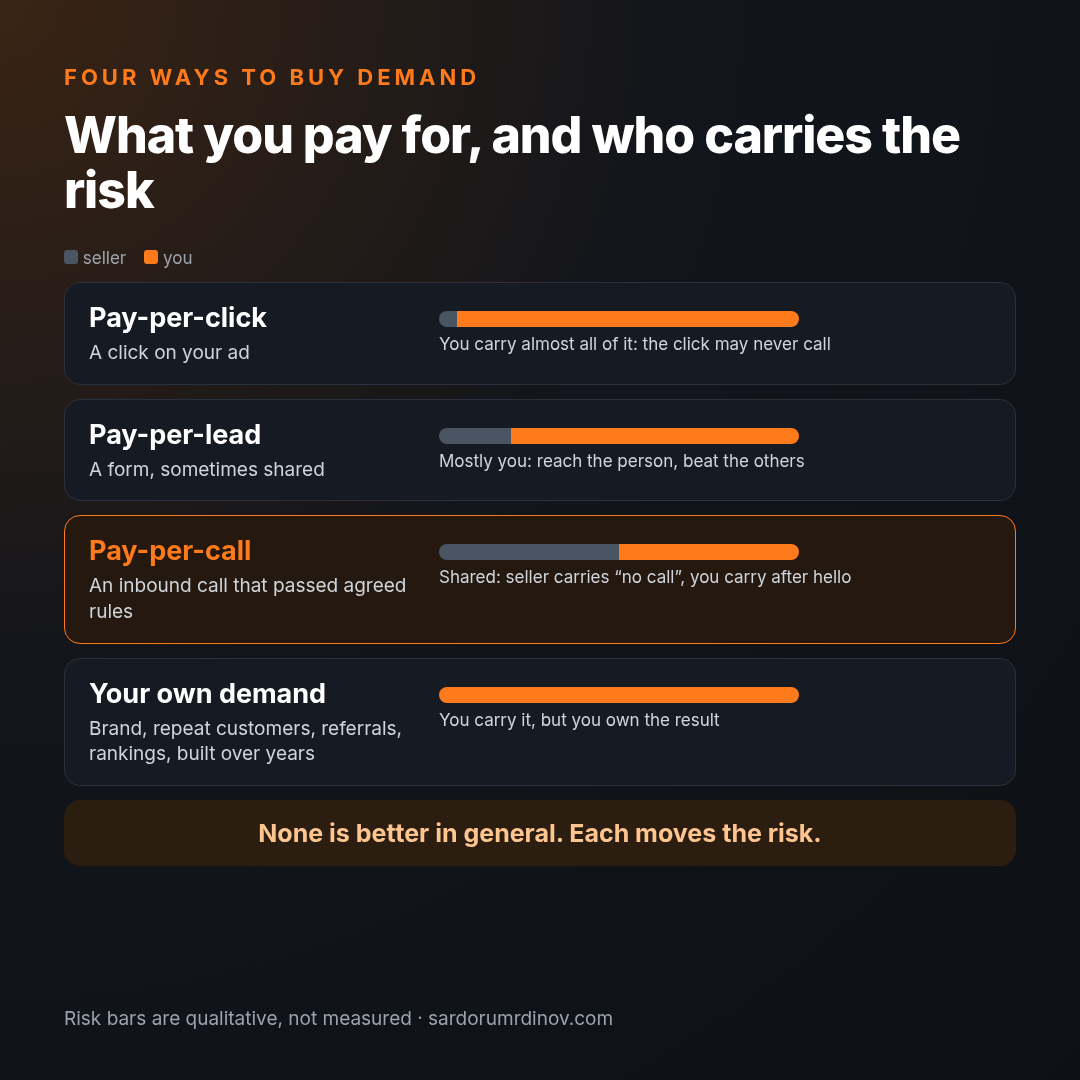
Google's own Local Services Ads sit close to this middle ground. Google says leads from those ads come in as phone calls and messages, and that the business pays only for leads related to the services it offers. None of these models is better in general. Pay-per-call moves the risk of "will anyone call?" to the seller, and leaves the risk of "will we turn this call into a job?" with you.
The math that decides whether it pays
Here is a simple example. Every number in it is illustrative, not taken from any company.
A buyer pays $100 for each billable call and takes 10 calls. That is $1,000. Suppose 6 of the 10 callers book an appointment and 4 of those appointments turn into paid jobs. The cost of demand per paid job is $1,000 divided by 4, or $250. If each paid job leaves, say, $300 of gross profit after parts and technician pay, the calls earned $50 per job before overhead.
Now change nothing about the calls. Same 10 calls, same $1,000. But the phone is answered slowly, price confidence is weak, and only 4 callers book and 2 become paid jobs. The cost per paid job doubles to $500, and each job now loses $200 against that $300 gross profit, before counting truck rolls on the two booked appointments that never paid.
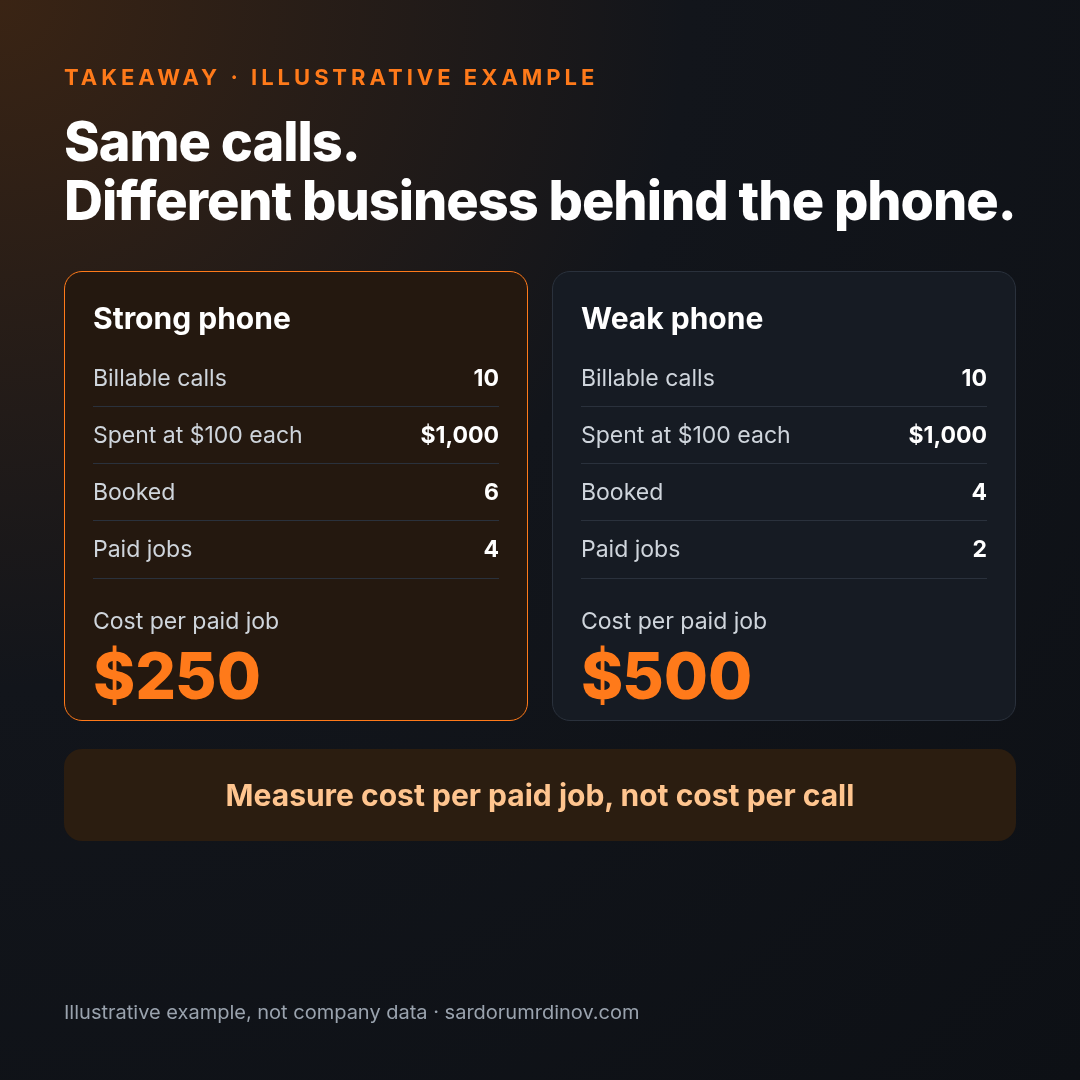
The calls did not change. The business behind the phone did. Disputes move the same math: every bad call credited back lowers your cost, and every one you forget to dispute raises it. That is why I tell owners to measure a call source by cost per paid job after disputes, not cost per call, and to compare sources only after the same team handled them under the same rules. In an earlier essay, Two Leads, Two Clocks, I wrote about measuring different kinds of demand on the clock that fits each one. Pay-per-call needs the same discipline.
The strongest case against pay-per-call
The best argument against pay-per-call is not that it is a scam. It is that the incentives in the chain point in different directions. A publisher is paid for calls that pass the filter, most commonly a duration threshold. So the publisher's incentive is long calls, not booked jobs. A network is paid on the spread between what buyers pay and what publishers earn, so its incentive is volume and margin. A buyer only makes money on jobs. When the only shared definition is "the caller stayed on the line for 90 seconds," every party can be doing its job and the buyer can still lose money. Coached callers, misleading ads and wrong-service callers all leak through a duration rule.
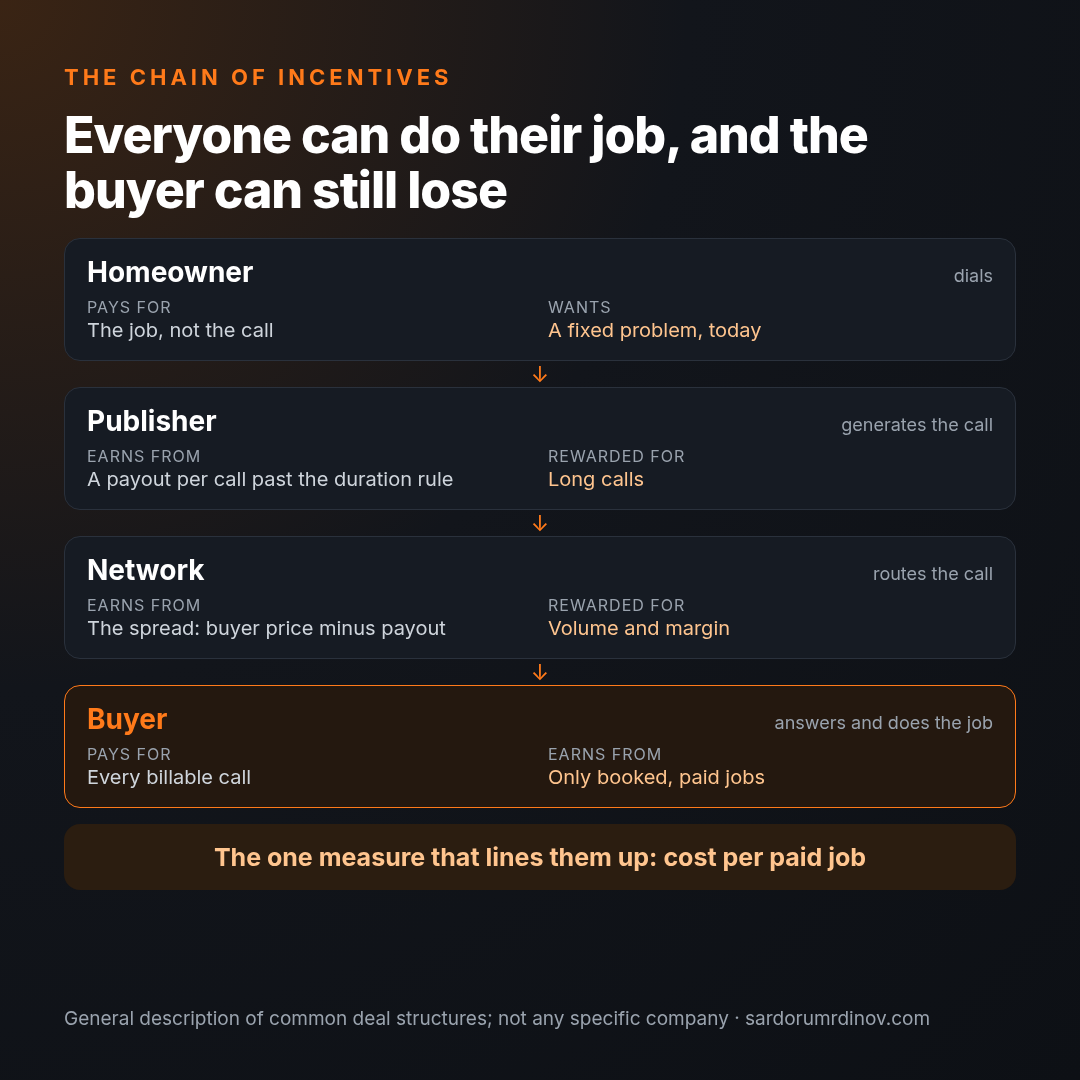
A second argument comes from capital allocation. Demand you rent stops the day you stop paying. Demand you own, from a brand, repeat customers, referrals and search rankings, compounds. A company that depends on rented calls has an acquisition cost it does not control and a growth engine it can lose overnight if a source dries up or prices rise. A sophisticated buyer of the business will see that.
A third argument is that the channel itself is moving. Search engines and AI assistants are starting to answer homeowners' questions and, in some cases, book services directly. If more first contacts happen there, fewer may arrive as a tracked phone call. That is a hypothesis to watch, not a forecast I can prove.
I take all three seriously. They don't make pay-per-call wrong. They make it a tool with a narrow job: filling real capacity with urgent, in-area demand, measured by paid jobs, while you build demand you own.
When pay-per-call works, and when it doesn't
It tends to work when:
- the trade is urgent and the ticket is large enough to absorb the cost of a call, as in many HVAC, plumbing and repair jobs;
- technicians are available to run the job soon;
- calls are answered live, quickly, by people with a clear price policy;
- you track every call to a booked job and a paid job, by source, and dispute bad calls on time;
- the rules are written down and match what you can actually serve.
It tends to fail when:
- you have no open capacity and buy calls to "keep the phones busy";
- calls go to voicemail or a slow call-back;
- the ticket is small, so even a good conversion rate cannot cover the cost;
- you judge sources by cost per call instead of cost per paid job;
- the ads behind your calls promise prices, speed or services you do not provide.
The compliance basics, in plain English
This is not legal advice, and the rules change, so check with counsel before you build anything.
Inbound pay-per-call differs from outbound telemarketing, because the homeowner chose to dial. The heavier rules under the federal Telephone Consumer Protection Act mostly concern calls and texts a business places to consumers, especially automated ones. That matters most for pay-per-lead, where a form submission may be used to justify calling someone back. The rules have moved recently: in 2023 the Federal Communications Commission adopted a requirement that consent be given to one seller at a time, and on January 24, 2025 the U.S. Court of Appeals for the Eleventh Circuit vacated that part of the order, holding that the FCC had exceeded its authority. Lead generators and buyers who rely on consent still need it to be clear and documented.
Recording is the other trap. Many deals record calls for quality and disputes. Some states require every party's consent to record a confidential conversation. In California, Penal Code section 632 makes intentionally recording a confidential communication without the consent of all parties a crime. Note that the whisper plays only to the buyer, so it does not tell the caller anything. A short disclosure to the caller at the start of the call is the usual answer, but get advice for the states you serve.
What this means for owners, publishers and investors
For a home service owner, pay-per-call is a flexible way to add demand where you have capacity. Its value depends on your phone, your price discipline and your tracking. If those are weak, fix them before you buy a single call. My essay Your ROAS problem isn't a marketing problem makes the same point about ad spend.
For a publisher, the durable business is not the longest calls. It is calls that buyers turn into jobs, because those buyers keep buying. A publisher who mixes undeclared sources or runs misleading ads may earn more this month and lose the buyer next month.
For an investor or acquirer, the question is how much of a home service company's revenue depends on rented demand, at what cost per paid job, and how concentrated it is in a few sources. Two companies with the same revenue are different assets if one owns its customers and the other rents them weekly.
Full disclosure: we run a pay-per-call and pay-per-lead marketplace for home services, LeadBank. Nothing in this essay relies on it, and every number here is from a cited public source or is a labeled example.
Five questions to ask before you buy a single call
- What exactly makes a call billable? Get duration, clock start, area, hours, duplicate window and service definition in writing.
- Is it exclusive or shared? And if shared, with how many buyers?
- Where does the traffic come from? Which sources are allowed, and how are they declared? One tracking number, one source.
- How do disputes work? Which reasons count, within how many days, and do you get the recording?
- Can I trace every call to a paid job? If you can't, you are buying calls without knowing what they earn.
Conclusion: what is supported, what is uncertain, what to test
What is supported: pay-per-call means paying for an inbound call that passes agreed rules, and those rules, not the word "call," define what you buy. The mechanics are a general description of how call-tracking platforms commonly work; details differ by deal. Each published payout range describes a single seller's marketplace, and the best public benchmark covers all inbound calls in one vendor's customer base, not paid calls. The Eleventh Circuit decision and California's recording law are matters of public record.
What is uncertain: how well pay-per-call performs for a typical home service company. I found no public, independent benchmark for conversion from paid calls to paid jobs, and no public source on billable or disputed shares. Prices and rules vary by trade, market, season and seller, and how fast AI search will change the flow of calls is unknown.
What to test: run any new call source as a small, capped trial in one market where you have capacity. Track answer rate, booking rate, paid-job rate, disputes filed and credited, and cost per paid job, next to your other sources, for more than one week. Keep the source only if it beats your alternatives on cost per paid job after disputes.
The phone ringing is not the goal. A paid, completed job is.
FAQ
What is pay-per-call in home services?
A home service company pays for an inbound phone call instead of an ad click or a web form, and only for calls that meet agreed rules: service type, area, business hours, no repeat callers and a minimum call length.
What is a billable call?
A call that passes the rules in the deal. Common rules: a minimum duration after connect (published examples run 60 to 120 seconds), a caller inside the service area, business hours, and no repeat call from the same number within a set window.
How much does a pay-per-call lead cost?
There is no public market price. One marketplace lists publisher payouts of $30 to $80 per qualified HVAC call and $25 to $70 for plumbing. Those are one seller's advertised ranges, not what you should expect to pay, and they say nothing about how many calls become jobs.